
Supreme Court Strikes Down Trump’s Trade War Powers: What’s Next?

In a 6-3 decision authored by Chief Justice John Roberts, the nation’s highest court struck down the bulk of President Trump’s far-reaching tariff regime, ruling that the International Emergency Economic Powers Act, the legal authority underpinning the so-called “reciprocal” tariffs imposed on nearly every country in the world, does not authorize the president to impose tariffs. Roberts wrote plainly: “When Congress grants the power to impose tariffs, it does so clearly and with careful constraints. It did neither here.”
It is a ruling that will be debated in Washington for years. But in warehouses, on loading docks, and in freight brokerage offices from Long Beach to Atlanta, the question is more immediate: what does this mean for what happens next?
The tariffs at the center of the case were those Trump imposed under IEEPA, representing approximately half of all tariff revenue the federal government was collecting each month, roughly $15 billion of the $30 billion monthly total. That number alone tells you the scope of what the Court unraveled.
The legal challenge consolidated a dozen cases from small businesses and states alike, all arguing that IEEPA, a 1977 statute that never once uses the word “tariff,” was never intended to give a president the power to restructure the entire global trading order. The majority agreed. The decision does not, however, touch tariffs imposed under other legal authorities: the Section 232 steel and aluminum duties remain. The 25% auto tariffs remain. The Fentanyl-related duties on Canada, Mexico, and China remain. What falls are the sweeping reciprocal tariffs Trump used as his primary negotiating tool against the world.
The practical consequences of the ruling are still being untangled. Justice Kavanaugh, writing in dissent, flagged what may become a years-long administrative headache: “The United States may be required to refund billions of dollars to importers who paid the IEEPA tariffs, even though some importers may have already passed on costs to consumers or others.” As of last December, the government had collected more than $130 billion from these tariffs alone.
To understand what the ruling means, you have to understand what the last twelve months did to the supply chain.
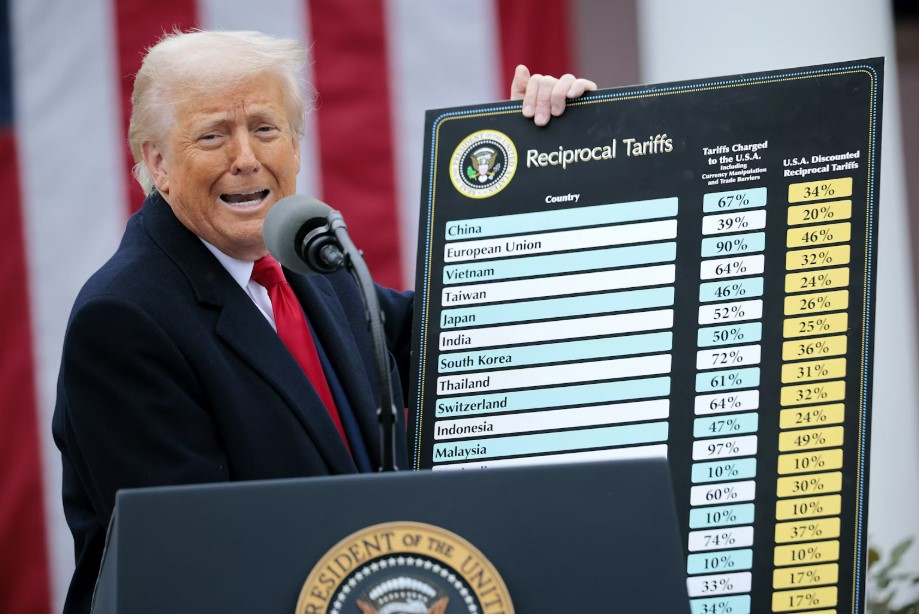
On April 2, 2025, “Liberation Day” in Trump’s framing, the administration unveiled a blanket 10% global tariff and country-specific duties reaching as high as 49%. The announcement sparked immediate market panic. In the months that followed, tariffs were paused, reimposed, escalated, and negotiated in ways that made long-range planning nearly impossible. From January to April 2025 alone, the average effective U.S. tariff rate rose from 2.5% to an estimated 27%, the highest level in over a century. By November, after a wave of deal-making, it had settled back to approximately 16.8%. The Tax Foundation estimated the tariffs functioned as the largest U.S. tax increase as a percentage of GDP since 1993.
The response from American business was immediate and rational: pull forward. The Port of Los Angeles recorded its second-best February on record as companies raced to build inventory buffers ahead of expected rate increases. By July, the Port had logged its single highest-volume month ever. The Port of Long Beach was tracking toward a new record, surpassing 2024’s 9.6 million TEU mark.
By the fall, the front-loading had run its course. Van truckloads were down 11% year-over-year by October. The Port of Seattle saw something it hadn’t seen since COVID, with no container ships docked at its terminal. The traditional peak holiday shipping season, in the words of DAT Chief of Analytics Ken Adamo, looked “virtually non-existent.”
The voices from the logistics and supply chain community over the past year have told a complicated story, one of resilience in some corners and genuine structural pain in others.
“Freight volumes in the third quarter and October reflect what we’re seeing in the broader goods economy, with shippers drawing on inventory built up earlier in the year to reduce their exposure to tariffs and weak consumer demand,” said Ken Adamo of DAT. “As a result, the traditional peak holiday shipping season looks virtually non-existent this year.”
Mario Cordero, CEO of the Port of Long Beach, connected the economic dots directly to the people doing the work. “Labor is absolutely concerned. When you have reduced volume, you’re going to have an impact on the jobs in the supply chain, certainly on the docks here at the Port of Long Beach.”
In trucking, the anxiety has been acute. Paul Brashier, Vice President of Global Supply Chain at ITS Logistics, saidy: “We are forecasting an increase in continued trucking company exits because of the lower freight volumes.” The manufacturing sector fared no better, with factories shedding 108,000 jobs in 2025, and as one unnamed factory manager told the Institute for Supply Management in December, “Morale is very low across manufacturing in general.”
The apparel and fashion supply chain offered one of the more direct assessments of how tariffs ultimately travel through the system. “Persistent tariffs and uncertainty will continue to complicate the ability of fashion supply chains to avoid high costs that are ultimately passed along to American consumers as higher prices,” said Stephen Lamar, President of the American Apparel and Footwear Association.
On the cargo side, the picture became increasingly stark as the year progressed. Hackett Associates Founder Ben Hackett projected that total 2025 cargo volume could see a net decline of 15% or more from earlier highs. “In this environment of complete uncertainty, our forecast for import cargo will be subject to significant adjustments over the coming months,” he said. That uncertainty calcified into a warning from NRF Vice President for Supply Chain and Customs Policy Jonathan Gold: “Retailers have been bringing merchandise into the country for months in attempts to mitigate against rising tariffs, but that opportunity has come to an end.”
Looking toward 2026, Brian Kobza, Chief Commercial Officer for IMC Logistics, offered a view that now reads as prescient: “Forecasting for 2026 presents considerable challenges due to various uncertainties, including tariff levels, AI impacts, and numerous possible global economic changes.” The Supreme Court just made that forecast even harder to build.
The Economic Picture
The macroeconomic data that has emerged over the tariff period paints a nuanced portrait. The Tax Policy Center estimated the tariffs imposed an average burden of $2,100 per U.S. household in 2026 alone, a figure that falls harder on lower-income households as a percentage of income. The Congressional Budget Office estimated the economic impact of Trump’s tariffs at $3 trillion over the next decade.
A working paper from Harvard professor and former IMF economist Gita Gopinath and Brent Neiman of the University of Chicago found that nearly all the cost of Trump’s tariffs were being paid by U.S. importers rather than foreign suppliers, directly contradicting a central White House talking point. In some cases, importers absorbed the cost in the form of lower margins. In others, they passed it downstream.
The freight analytics firm Sea-Intelligence offered a particularly striking framing in early February 2026, just two weeks before the Court’s ruling. CEO Alan Murphy described a kind of economic mirage at work: “This is the payback period of suppressed volumes following 2025’s front-loading, combined with the reality that trade policy shifts where the higher U.S. tariff cost base is approximately 18.5 percent. In this environment, a ‘steady’ economy will not provide the booming consumer demand required to absorb these higher costs.”
Arizona State University supply chain professor Dale Rogers, who monitors the Logistics Managers’ Index, warned that inflation was working its way through the pipeline in ways not yet visible at the consumer level. “The fact that transportation and inventory prices are higher but warehouse prices didn’t really move indicates to me that probably we are seeing inflation that has not yet been picked up at the consumer tier of the supply chain,” he said in early February 2026.
The ruling does not mean a return to the pre-tariff trading environment. The Trump administration has already indicated it will work to preserve the tariff framework through other legal authorities, and the mechanisms are slower and more constrained, but they exist. And Congress, given the current composition, is unlikely to fill the gap quickly or cleanly.
What the ruling does do is fundamentally alter the negotiating posture that has defined U.S. trade policy for the past year. The threat of rapid, sweeping tariff action that could be imposed without congressional action is now substantially diminished. Trading partners will recalculate. Importers will recalibrate. Freight markets, which have been distorted in both directions by tariff-driven front-loading and demand suppression, will need to find a new equilibrium.
The refund question is itself a supply chain problem. Importers who paid IEEPA tariffs, potentially billions of dollars worth, will have claims. But many of those importers already passed costs downstream. Untangling who owes what to whom through a supply chain that spans manufacturers, brokers, carriers, and retailers will take time and legal creativity.
For the logistics and supply chain industry, this moment calls for the same discipline it has always demanded: scenario planning under uncertainty, relationship-building with trading partners and customs counsel, and an honest look at where sourcing diversification investments made over the past two years actually delivered resilience, and where they merely reshuffled risk.
Supply Chain Moves covers analyst relations, go-to-market strategy, and industry intelligence for logistics and supply chain companies navigating a rapidly changing market.