
From $5.8 Billion to Advisory: A Run of Logistics Deals Built Around Data

Three acquisitions since late August, at C.H. Robinson, Descartes and Redwood Logistics, have each been framed around data, AI or both.
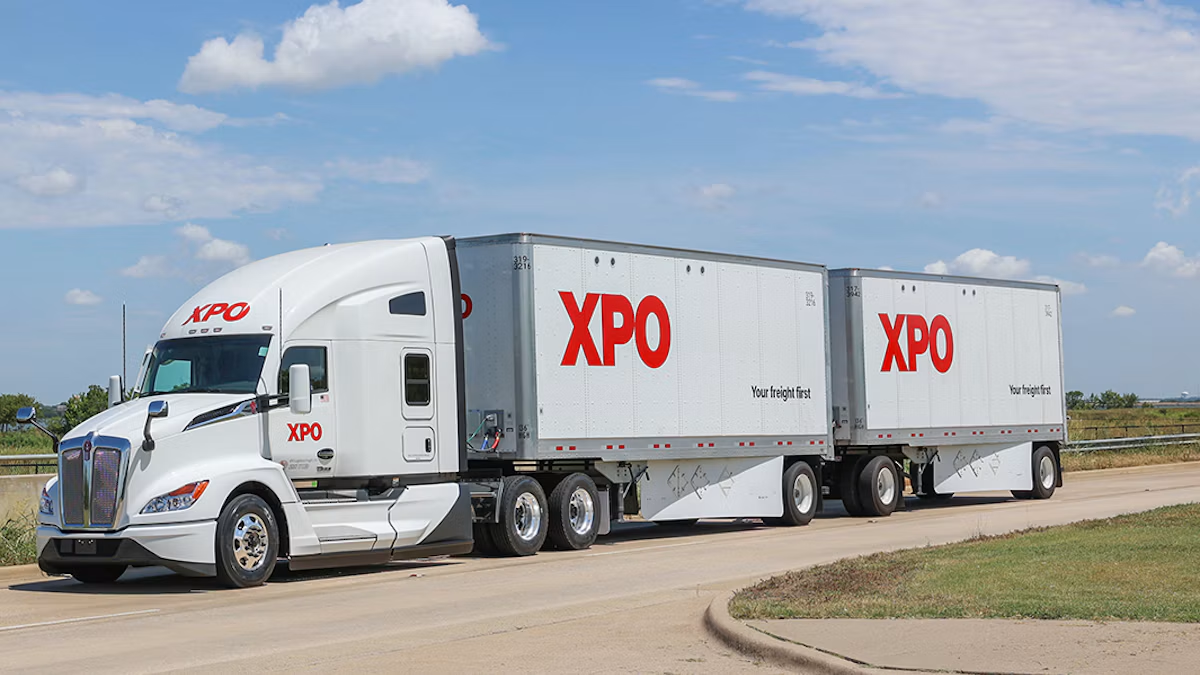
The largest was C.H. Robinson’s $5.8 billion cash-and-stock agreement to acquire RXO, announced October 5. The deal would combine the companies’ North American freight brokerage and managed transportation businesses into a company with an enterprise value of more than $25 billion, and RXO shareholders are set to receive $30.25 per share, a 29% premium. RXO itself came out of earlier rounds of consolidation. XPO spun it off in November 2022, and it grew substantially in 2024 with its purchase of Coyote Logistics from UPS. Robinson built its case largely on cost, projecting about $300 million in annual net savings within two years of closing by applying its Lean AI operating model to RXO’s business. Robinson said the deal would also expand its proprietary datasets. Closing is expected in the first half of 2027, pending regulatory and shareholder approval. Trans.info placed the deal within a broader push by large logistics groups to protect margins through cost cuts and automation while transportation demand stays soft.
Six weeks earlier, the same brokerage market drew a software deal. The Descartes Systems Group acquired Tai in August for approximately $100 million in cash. Tai sells a transportation management platform built for freight brokers that handles quoting, carrier sourcing, load execution and billing across truckload, LTL, drayage and cross-border freight. Descartes described the purchase partly as a data acquisition, saying it adds transaction, carrier and shipment execution data to its Global Logistics Network. Tai now sits alongside MacroPoint, MyCarrierPortal and Aljex in the Descartes portfolio, and the company plans to feed MacroPoint and MyCarrierPortal carrier data into Tai’s quote automation and AI workflows, according to FreightWaves. The deal was Descartes’ third acquisition of 2026, after three in 2025 that included TMS provider 3GTMS for $115 million.
Redwood Logistics moved toward the point where shippers make those technology decisions. The Chicago-based 4PL acquired JBF Consulting, a vendor-agnostic technology advisory firm in Guilford, Conn., with more than 20 years in logistics, and used it to form [Redwood Advisory](LINK PENDING). The practice advises shippers on network strategy, operating model design, TMS, WMS and GTM selection, and data and AI readiness, and continues working with them after implementation. Shippers can hire it on its own or as an entry point to a 4PL relationship. Erin Breen, Redwood’s chief growth officer, said customers wanted Redwood involved earlier, before choosing a TMS or launching an AI program. “Building an advisory team from scratch would have taken us years,” she said. JBF founder and CEO Brad Forester joined Redwood with the JBF team, along with Tara Buchler, a former e2open product management vice president, as principal of strategy.
Redwood and JBF cited their own survey data. In a March 2026 JBF survey of senior supply chain, logistics and technology leaders, nearly 42% said they were not confident in their organization’s ability to independently evaluate complex logistics technology, and only 4% strongly agreed their organization distinguishes a technology business case from its broader supply chain strategy. Redwood’s 2026 AI in Logistics Report found only 13% of shippers deploying AI are generating quantifiable results, with data quality and integration gaps as the top barriers.