
Einride and EASE Logistics Put Driverless Electric Trucks Into Daily Freight Service in Ohio

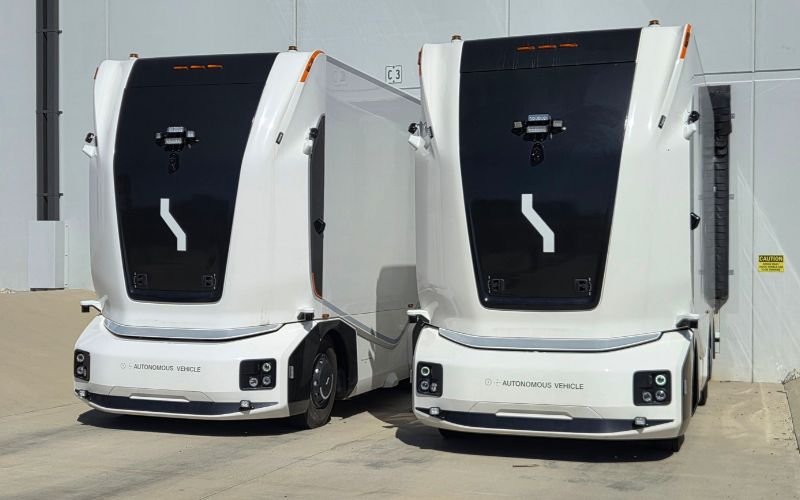
Two cabless, driverless electric trucks from Einride are now moving freight every day between EASE Logistics warehouses in Marysville, Ohio, the companies announced Oct. 6. The SAE Level 4 trucks run scheduled routes on EASE property and local public roads with no one aboard. A remote operator monitors each truck from off-site and can step in if needed.
The deployment follows a proof of concept the companies announced in May. It is part of the Truck Automation Corridor Project, an $8.8 million, multi-year program launched in 2021 by the Ohio Department of Transportation, DriveOhio and the Indiana Department of Transportation to prepare major routes in both states for automated freight. This is EASE’s third autonomous trucking deployment with DriveOhio. The Columbus-based company, which runs a third-party logistics business and an asset-based transportation and warehousing unit, tested truck platooning on Interstate 70 in 2025, Trucking Dive reported.
The companies began collecting operating data on safety, reliability and efficiency in September. They have not released figures on miles driven, loads moved or uptime, and say that data will shape the next phase and inform talks with ODOT, INDOT and prospective logistics partners. The announcement did not give route length, operating speeds or how many trucks each remote operator oversees.
Einride Chief Technology Officer Henrik Green said in the announcement that daily service in Marysville gives the company the proof it needs to expand autonomous freight along the corridor and beyond. “EASE believes in leading through action and putting innovation to work in real-world operations,” said Peter Coratola Jr., president and CEO of EASE Logistics.
EASE told FreightWaves it joined the project partly to give operators a voice so regulators don’t write autonomy rules without operational input. It is also studying what the trucks need in staffing and timing. The company sees an opportunity in moving empty racks autonomously, which would reduce unplanned driver dispatches. It said taking older drivers out of the cab could keep them in the industry longer, and that it is not trying to eliminate driver jobs.
Einride, founded in Stockholm in 2016, designs its trucks without a cab and sells both freight capacity and software. It began trading on Nasdaq on June 10 under the ticker ENRD, after closing a merger with special purpose acquisition company Legato Merger Corp. III that valued Einride at about $1.35 billion before new investment. In March, the company received approval from the National Highway Traffic Safety Administration to operate its autonomous truck in Austin, Texas. That was its fifth U.S. approval, after Arizona, Colorado, South Carolina and Tennessee, CCJ reported.
The Ohio operation runs short warehouse-to-warehouse loops. Most U.S. driverless freight volume moves on Texas interstates in conventional Class 8 tractors fitted with autonomy systems. Aurora Innovation began commercial driverless service between Dallas and Houston in May 2025. In its third-quarter shareholder letter, Aurora reported $3 million in revenue from driverless and supervised loads. It said it expects production to reach about 20 trucks a week by early December and remains on track to have more than 1,000 driverless trucks operating by the end of 2027. The company also said its production ramp was running about six weeks behind plan. It pushed its 200-truck driverless fleet milestone from year-end to the end of February and lowered its full-year revenue outlook to about $9 million, from the $14 million to $16 million it guided in February.
Kodiak AI plans to launch unsupervised driverless service by the end of 2026 on a 219-mile stretch of Interstate 45 between the Dallas and Houston areas, with IKEA as the launch shipper. The launch depends on Kodiak completing its highway safety case, Trucking Dive reported. Kodiak has run driverless trucks commercially off-highway for Atlas Energy Solutions in the Permian Basin since December 2024.
Federal regulators cleared one operational barrier this fall. On Oct. 7, the Federal Motor Carrier Safety Administration granted a five-year exemption allowing qualifying Level 4 autonomous trucks to use cab-mounted warning beacons in place of the reflective triangles that federal rules require a driver to set out within 10 minutes of stopping on a highway or shoulder. FMCSA weighed 402 public comments before deciding. The Owner-Operator Independent Drivers Association and highway safety groups opposed the exemption, and OOIDA had urged the agency to wait for results from its own study of warning devices. The exemption leaves the requirements unchanged for human-driven trucks. FMCSA wrote that updating warning-device rules for all commercial vehicles could be a subject for future rulemaking, after the Autonomous Vehicle Industry Association and Volvo asked that beacons be allowed on conventional trucks, according to FreightWaves.