
Carrier Identity and Authorization is Driving Cargo Theft Increase

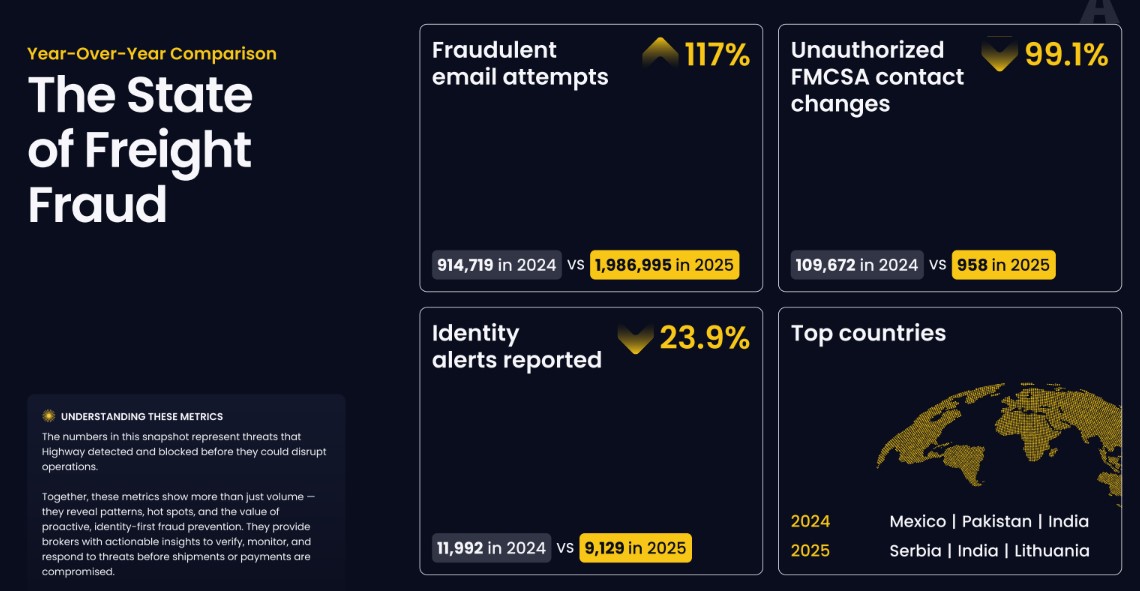
The Highway Q4 2025 Freight Fraud Index reveals that detailing a clear shift in stolen-load activity driven by gaps in carrrier identity and authorization, including a 117% increase in fraudulent email attempts.
By year-end, direct thefts accounted for nearly half of reported stolen loads, increasingly tied to carriers with legitimate operating histories, real equipment and familiarity with broker and shipper workflows.
“Direct theft is the hardest to combat because these carriers were once trusted. There’s no crystal ball to predict when someone with a clean history is going to break bad, and we’re seeing the same playbook show up across channels. In 2025, Highway blocked 1,986,995 fraudulent email attempts, up 117% from 914,719 in 2024, flagged and blocked 8,525,962 fraudulent phone numbers, and issued 9,129 identity alerts across our network,” said Michael Grace, Vice President of Risk at Highway.
Highway’s Q4 2025 analysis highlights three primary fraud vectors affecting brokers and their carrier networks: direct theft (carrier-involved theft), compromised inboxes and manipulated identities, including ownership changes or “sold MC” scenarios.
Among the most targeted commodities in the analysis were food and beverage, electronics, copper, protein powder and cosmetics. The report also points to California, New York, Illinois, Texas and Indiana as key areas of activity.
Highway’s Risk team identified a measurable increase in direct theft incidents coinciding with heightened regulatory and licensing scrutiny, particularly related to non-domiciled commercial driver licensing. As federal and state scrutiny intensifies, some carriers viewed their ability to legally haul freight as time-limited, increasing the likelihood of sudden, high-risk behavior from previously compliant operators.
Public audit findings reinforce this trend. Industry research has found that more than 25% of non-domiciled CDLs in California were improperly issued, including licenses that remained valid beyond the holders’ authorized stay. In response, the state announced plans to revoke approximately 17,000 improperly issued CDLs. At the federal level, regulators have warned that states failing to align with Federal Motor Carrier Safety Administration (FMCSA) licensing standards may face withheld highway funding.
From a risk perspective, this regulatory tightening introduces instability into parts of the carrier population. In multiple Q4 investigations, Highway observed carriers with long delivery histories and previously clean records executing direct thefts shortly before license expiration, revocation, or anticipated enforcement action.
These incidents were not opportunistic — they were calculated, multi-load events carried out by drivers and fleets with deep operational familiarity.
As enforcement activity accelerates into 2026, Highway is closely monitoring the regulatory-driven risk signals that are expected to play a larger role in freight theft patterns. Brokers using Highway have the ability to limit access to carriers with flagged or non-domicile statuses, reducing exposure to high-risk drivers.
“Direct theft is the hardest to combat because these carriers were once trusted. There’s no crystal ball to predict when someone with a clean history is going to break bad,” said Grace.